

Written by Dr. Asmat Ullah Khan, DVM | Last Reviewed: December 2025
Medical Disclaimer: This article is for educational purposes only and is not a substitute for veterinary examination, diagnosis, or individualized behavior treatment. If your dog shows fear, aggression, or does not respond to gentle handling, consult a veterinarian or certified behaviorist.
The 12 easy commands every dog should learn by age 1 are: name response, sit, down, stay/wait, come, leave-it, drop-it/give, loose-leash walking, go-to-mat/place, off, wait at doors, and settle. These basic dog commands support safety, prevent behavior problems, and set puppies up for lifelong manners.
🐾 Why Teaching Commands Before Age 1 Matters
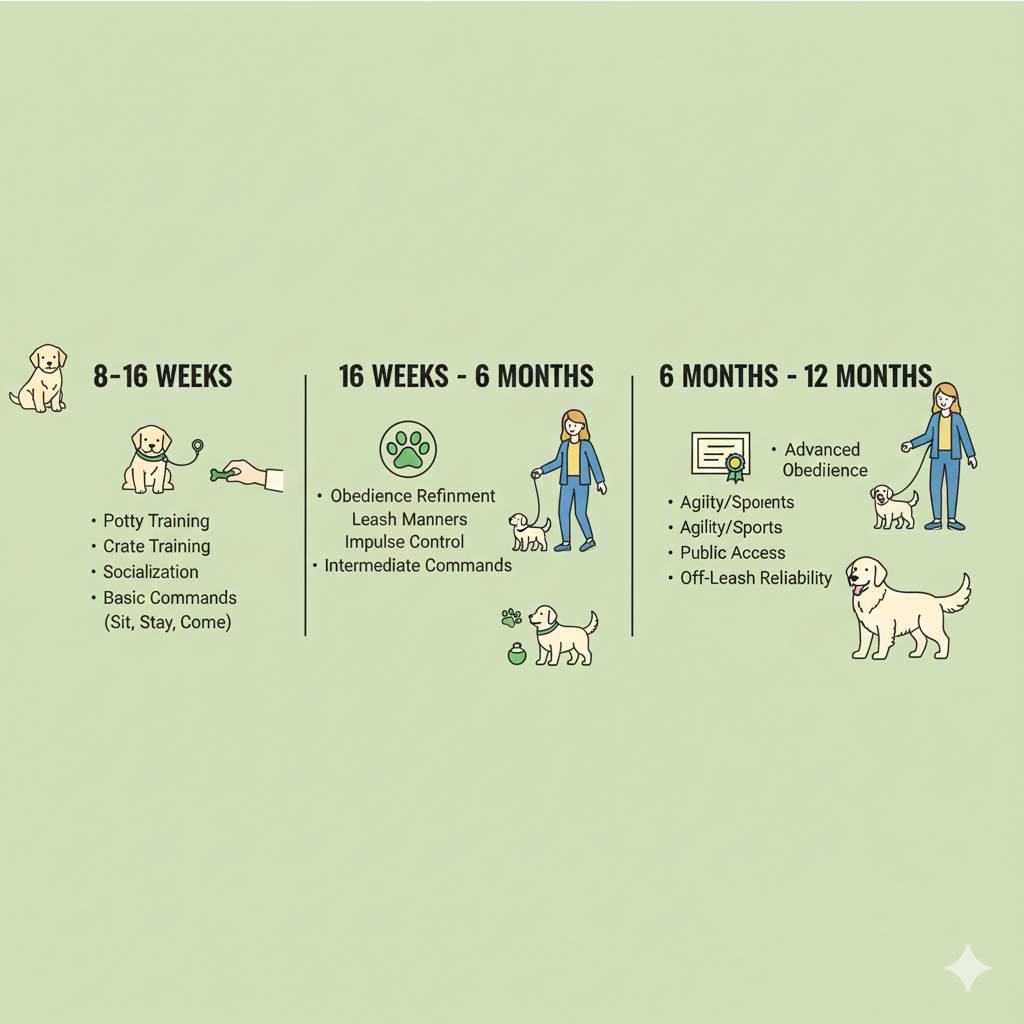
Most owners think puppies will just grow out of bad habits without training — but behavior does not “fix itself.” Puppies pass through critical learning windows, especially between 8–16 weeks, where experiences shape future behavior. Guidance from Blackwell’s Five-Minute Veterinary Consult — “Puppy Socialization and Puppy Classes,” pp.1158–1159 shows that early, reward-based training reduces anxiety, improves coping skills, and prevents unruly behaviors that often lead to rehoming.
Adolescence (6–18 months) is when biting, jumping, running away, or guarding household items often begin. Teaching clear communication through cues gives young dogs an alternative behavior to choose instead of chaos — sit instead of jumping, leave-it instead of swallowing danger, come instead of bolting.
Training is not about dominance or “showing who’s boss.” It’s teaching puppies how to succeed in human homes using force-free, positive reinforcement — food, praise, play, and consistency.
🏆 The 12 Easy Commands Every Dog Should Learn
Below are the essential “basic dog commands” — simple, everyday behaviors that owners can use anywhere from parks to vet clinics. Each ties directly to safety, household peace, and emotional wellness.
1️⃣ Name Response (“Name!” — Look at Me)
What it is: The dog turns their head toward you when you say their name.
Why it matters: This is the gateway cue — nothing else works if the dog isn’t paying attention.
Vet-based benefit: Establishes handler orientation, emphasized in Blackwell’s — “Unruly Behaviors…Dogs,” pp.1361–1363.
2️⃣ Sit
What it is: Bottom touches floor on cue.
Why it matters: “Sit” is your polite default — for food, doors, greetings, and preventing jumping.
Clinical reference: Blackwell’s — “Behavioral Problem Prevention, Puppies,” pp.115.e4–115.e6.
3️⃣ Down
What it is: A relaxed, low-energy position.
Why it matters: Helps at cafés, vet waiting rooms, or when guests arrive.
4️⃣ Stay / Wait
What it is: Hold position until released.
Why it matters: Safety at curbs, car doors, and during vet exams. Blackwell’s — Puppy Classes section, pp.1158–1159.
5️⃣ Come (Reliable Recall)
What it is: Dog returns when called.
Why it matters: The number one life-saving cue — prevents road accidents, lost dogs, and conflict. Supported by Blackwell’s — “Unruly Behaviors…Dogs,” pp.1361–1363.
6️⃣ Leave-It
What it is: Ignore or disengage from an object — food, trash, pills, animals, or street hazards.
Why it matters: Prevents toxin ingestion, foreign-body surgery, and high-cost emergencies.
7️⃣ Drop-It / Give
What it is: Release items from the mouth.
Why it matters: Stops tug-of-war battles, prevents swallowed socks, and reduces resource-guarding.
8️⃣ Loose-Leash Walking
What it is: Walk calmly without pulling.
Why it matters: A welfare issue and a relationship issue — walks should be enjoyable, not stressful. Reward-based walking is recommended over choke or prong tools, per Blackwell’s — “Behavioral Problem Prevention, Puppies,” pp.115.e4–115.e6.
9️⃣ Go to Mat / Place
What it is: Dog moves to a defined bed or rug and relaxes.
Why it matters: Household-sanity cue — wonderful for dinner time, doorbells, and multitasking.
Reference: Blackwell’s — Behavioral Prevention section, pp.115.e4–115.e6.
🔟 Off (Paws Off)
What it is: Dog removes paws from people or counters when asked.
Why it matters: Reduces jumping, food theft, and accidental scratches.
1️⃣1️⃣ Wait at Doors / Gates
What it is: Pause before crossing a threshold.
Why it matters: Prevents bolting into streets or parking areas. Helps puppies develop impulse control.
1️⃣2️⃣ Settle
What it is: Trained relaxation — calmly resting at your feet or mat.
Why it matters: Builds emotional resilience and helps with anxiety, vet visits, and busy homes.
👨⚕️ Dr. Khan’s Clinical Corner
“In practice, the single cue that has prevented the most emergencies is a rock-solid ‘leave it.’ Teaching puppies to instantly disengage from anything on the ground has stopped dogs from grabbing rodenticide blocks in garages, dropped ibuprofen tablets, and even chicken bones on walks. It is trained first on boring objects with high-value food rewards, then gradually generalized to food, toys, and real-life street trash, always rewarding the decision to turn back to the owner. This one behavior dramatically reduces the risk of toxin ingestion and foreign-body surgery in young dogs.”
— Source: Blackwell’s Five-Minute Veterinary Consult — “Unruly Behaviors: Jumping, Pulling, Chasing, Stealing—Dogs,” pp.1361–1363.

🔬 Research Radar — Veterinary-Based Summary
(Links embedded per rule — only from your list)
Many foundational skills are echoed in trainer and veterinary resources such as AKC’s recommended puppy commands, the Gallant list of basic dog commands, early-training guidance from Dogs Inc. trainer article, and real-owner discussions like r/puppy101 on what commands to teach first.
The veterinary foundation behind these recommendations comes from:
- Blackwell’s — Puppy Socialization and Puppy Classes, pp.1158–1159
- Blackwell’s — Behavioral Problem Prevention, Puppies, pp.115.e4–115.e6
- Blackwell’s — Unruly Behaviors: Dogs, pp.1361–1363
- Clinical Veterinary Advisor — puppy behavior client handout, 4th ed.
🚨 Emergency Red Flags — When to Seek a Vet or Behaviorist
Call a veterinarian or ER immediately if you notice:
- Your puppy repeatedly tries to eat rocks, toys, trash, or pills (pica or foreign-body risk)
- Snapping, growling, biting to protect food/toys during “drop-it” attempts
- Bolting toward a road and cannot be interrupted
- Frozen, trembling, whale-eye, tail tucked tightly during training → potential fear or trauma response
🏠 Safe Home-Training — How to Practice Humanely
Based on Blackwell’s — Behavioral Problem Prevention, Puppies, pp.115.e4–115.e6:
- Use food, toys, praise — NOT choke chains, prongs, or electronic collars
- Train in 3–5 minute bursts; puppies fatigue fast
- Reward calmness more often than excitement
- If a cue fails → lower difficulty → reward success
- Puppies do not “misbehave on purpose” — they lack skills, not morals
📆 30-Day Mini Puppy Plan (Owner Cheat-Sheet)
| Week | Focus Commands | Goal |
|---|---|---|
| Week 1 | Name, Sit, Marker Cue | Create communication |
| Week 2 | Down, Leave-It | Build control + prevent ingestion emergencies |
| Week 3 | Drop-It, Recall | Improve safety outdoors |
| Week 4 | Mat/Place, Wait at Door, Settle | Household harmony |
Q1 — What are the very first commands a young puppy should learn, and how do these early cues shape their behavior in the long run?
The first skills to teach include name response, sit, come, and leave-it, because they open the door to communication. Puppies that learn these early develop better impulse control and safer habits outdoors and indoors. These cues help avoid emergency situations, prevent jumping and mouthing, and set the foundation for all future training.
A: Start with one small cue at a time, reward heavily, and celebrate wins. Short, positive sessions help your puppy succeed without stress.
Q2 — How long should training sessions last, and how many times per day should I practice basic dog commands?
Most puppies have extremely short attention spans and can become overstimulated easily. Owners often think training must be long and formal, but research shows frequent, tiny sessions are far more effective. A few minutes a day can dramatically change behavior.
A: Aim for 3–5 minutes, 2–3 times daily, and end every session with success and play.
Q3 — Can a dog older than 1 year still learn these easy commands, or is training pointless in adulthood?
Many owners worry they “missed the window,” especially with adopted or rescued dogs. While early learning makes training easier, dogs at any age can improve, bond, and learn new habits. Adult dogs often learn faster because they can focus better than young puppies.
A: Yes — training works at any age. For older or anxious dogs, start slow, reward calmness, and remove pressure.
Q4 — What treats or rewards work best when teaching basic dog commands, and do I need food forever?
Food is a tool, not a bribe, and puppies naturally work harder for tasty, soft rewards. Owners sometimes fear they’ll need treats forever, but rewards phase out over time as habits form.
A: Use pea-sized soft treats, fresh chicken nibs, cheese crumbs, or a favorite toy. Once a cue is reliable, you can switch to praise, petting, or play as the reward.
Q5 — What should I do if my puppy refuses to follow a command or acts “stubborn,” especially during distractions?
Puppies don’t ignore cues because they’re defiant — they’re overwhelmed, tired, or not yet trained at that difficulty level. Owners often accidentally raise the challenge too quickly (e.g., trying a recall at a park full of squirrels). Lowering the difficulty makes success possible.
A: Go back one step — easier environment, shorter time, fewer distractions — and reward even tiny progress.
Q6 — Should I use tools like choke chains, prong collars, or shock devices if my puppy is pulling or not listening?
Harsh equipment is often recommended online, but research and veterinary behavior texts warn they increase anxiety, fear, and aggressive responses. Puppies need emotional safety to learn well.
A: Stick with force-free training, treats, body language coaching, and tools like a front-attach harness instead.