Dog Health
What Happens During a Dog’s Abdominal Ultrasound?
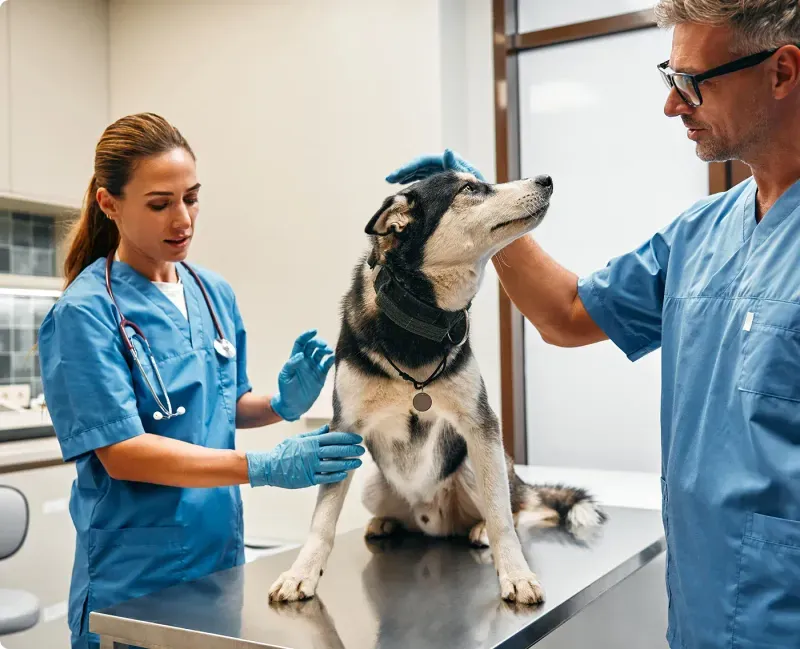
No radiation, no pain, a lot of information. What an ultrasound can (and cannot) show, how to prepare your dog, and what the results actually mean.
When blood tests and X-rays leave questions unanswered, ultrasound is often the next step. It lets us watch the abdominal organs in real time — their size, shape, internal structure and blood flow — without surgery and without radiation.
What ultrasound shows well — and its limits
Ultrasound excels at soft-tissue detail: the liver, spleen, kidneys, bladder, prostate or uterus, lymph nodes, adrenal glands and the layers of the stomach and intestinal wall. It can detect fluid in the abdomen, many masses, bladder stones, gallbladder problems and pregnancy. It is less useful for air-filled structures and cannot, by itself, tell us what most masses are — many benign and malignant lesions look similar, which is why sampling (below) is often part of the same procedure.
Preparing your dog
- Fasting: usually 8–12 hours with no food (water is fine) — food and gas in the stomach hide important structures. Confirm timings with your clinic.
- A full-ish bladder helps bladder assessment, so avoid a long walk immediately before the appointment if you can.
- Clipping: a patch of tummy fur is clipped — sound waves cannot travel through hair. It grows back.
- Sedation: many dogs lie calmly with gentle restraint and treats; anxious or painful dogs may be offered light sedation for better images and a better experience.
During the scan
Your dog lies on a padded trough or table, usually on their back or side, while the vet moves a probe over gel on the skin. The scan typically takes 20–40 minutes. If an abnormality needs sampling, a fine needle can be guided by ultrasound to collect cells (fine-needle aspirate) — most dogs tolerate this well, and it often provides the diagnosis without surgery.
Afterwards
There is no recovery from the scan itself. Results may be explained the same day, though aspirate samples sent to a laboratory take a few days. Ask two questions: ‘What did the scan rule in or out?’ and ‘What is the next step if this sample is inconclusive?’ — ultrasound is one piece of a diagnostic puzzle, not the whole picture.
Frequently asked questions
Does an abdominal ultrasound hurt a dog?
No. The probe presses gently on the skin. The main challenges are lying still and having a patch of fur clipped; light sedation is offered for anxious or painful dogs.
Why does my dog need to fast before an ultrasound?
Food and gas in the stomach and intestines block sound waves and hide organs behind them. An 8–12 hour fast (water allowed) gives much clearer images.
Can ultrasound diagnose cancer in dogs?
It can find and characterise masses, but many benign and malignant growths look alike on scan. A needle sample of cells is usually needed for a definite diagnosis.